Steph O’Donnell spoke at a Refugee Action Coalition forum on how her action on board an Air China flight helped stop a deportation from Sydney in December
I’m going to talk a bit about my experience, what happened on the flight on 19th of December and also a bit of history surrounding forced deportations and what can be done moving forward.
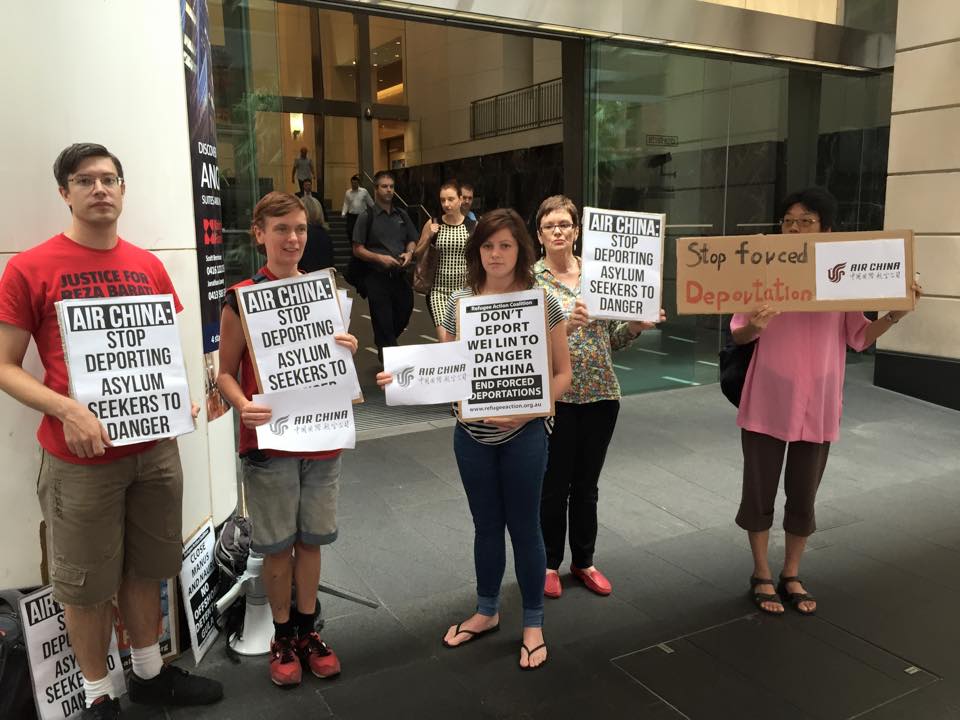
On the evening of 19th of December 2014, myself and my partner, were on our way to Heathrow via Beijing. We had just booked in for the cheapest flight going and fortunately moons aligned and there we were waiting in line to check in for flight CA174, when a plucky activist approached to inform us, a Chinese Asylum Seeker would be forcibly deported back to China, on this very same flight. She asked for us to stand up for this asylum seeker. Quite literally, refuse to sit down until he is removed from the flight. She said the success of an on board protest like this is unprecedented in Australia.
Unprecedented but not impossible.
 I had not been familiar with forced deportations. I have always felt very strongly about the treatment (or mistreatment) of refugees, quietly balling my fingers and toes into angry little fists as our nation’s leaders race to the bottom, in a fight over which party can more efficiently and reprehensibly mistreat fellow human beings. A seemingly determined and persistent quest to turn their backs on the responsibilities they had previously agreed to adhere to upon signing the Refugee Convention.
Australia willingly undertook the responsibility to resettle and protect victims of war, terrorism, displacement, injustice, persecution. They agreed that asylum seekers, vulnerable and desperate could legally seek asylum in Australia through any means possible and that we would safeguard them until permanent settlement can be organised. Australia is obliged not to return refugees to face the danger of persecution.
The reality now is Australia is breaking international law through their refoulement processes, not to mention contributing severely to existing global issues.
I often see Malcolm Fraser’s quote float about Facebook, “…if people are genuine refugees…there is no deterrent we can create which is going to be severe enough, cruel enough, nasty enough to stop them fleeing the terror from which they face in their own lands.”
There is no crueller response than to forcibly return refugees to the terror from which they escaped.
Stopping Wei’s deportation
Upon learning that Chinese Asylum Seeker, Wei Lin would be on my flight, I felt sad, embarrassed. Disgusted with the idea of a refugee being forcibly deported, I was completely unwilling to be complicit in any of it.
When we boarded, I could not see Wei Lin, tucked out of sight in the very back of the aircraft, between two security guards. Not until that desperate, brave, stupid but incredibly genius man ran up the right aisle of the plane did everyone see him. I didn’t have a visual of what happened when he reached the front of the plane but I did see him as the guards dragged him back, shackled wrists in the air and a face mask pulled down around his neck. He yelled out, “This is how they treat me”
There was chatter and shocked expressions everywhere. I noticed a small group of passengers congregating by the attendant quarters. I shuffled over to see what was happening. He will be removed from this flight, I thought. There wasn’t a doubt in my mind. Everyone saw it, everyone saw the shackles, the face mask, and the inhumanity. The big dirty secret.
I sidled up to the group, as fellow passengers expressed concern about their safety and security whilst on board. People have asked me a number of times, if I think others raised concerns because they thought there was an actual security threat or because they disagreed with the situation. I staunchly want to believe the latter but I don’t know. A bit of both, I suppose. It was certainly convenient that by running up the aisle, Wei Lin was able to provide a legitimate, timely, universal concern of a threat to security.
It was obvious there was no security threat. His intention was not to bring down a plane. It was to cause a stir, raise awareness, and ignite recognition, reaction to his situation.
Seven passengers, including myself continued to speak with Air China staff, pleading with them to remove this man from the plane. Requesting to speak with the pilot and refusing to sit down until we were heard and Wei Lin was taken off the aircraft.
A representative from Sydney Airport came on board. She explained that she understood our concerns but there was nothing that could be done because this was an official Immigration matter. I said to her “Air China should be under no legal obligation to carry out the bidding of Australian immigration, especially when it is not in their interest to do so. There are passengers aboard not willing to travel alongside a forced deportee.” I explained, that “we do not agree with what is happening and we’re standing up because we refuse to be complicit in this”. She said she would take our concerns to someone higher and would be back shortly. She was not.
Over an hour had passed since Wei Lin ran up the aisle.
We stood waiting for another representative.
The attendants secured the doors.
The plane began to taxi.
Still refusing to sit down, we demanded to speak with the pilot, disgusted that we were not being taken seriously. The plane continued up the tarmac. Only fuelling our anger.
We continued to stand.
Unfortunately, other passengers called us wankers, told us to give it a rest, indicative of the continuing fight to shift majority public opinion to support refugees.
A flight attendant approached us and said if we do not take our seats, we would be removed from the flight.
As paying customers and human beings exercising our civil right, we were infuriated…. And expressed this infuriation.
A message in Chinese came over the speaker. We asked the attendant what was happening. She said we are returning to the gate and the man in question will be removed from the plane.
Sceptical, I didn’t know if I should cry, clap or collect my own bags.
We pulled up at the gate and still standing we watched as Wei Lin and his Serco guards were removed from the plane. We clapped and cheered. Others clapped and cheered for the situation to finally be resolved. Wei Lin thanked us. I felt elated.
I was so sure everyone would stand in protest, I was sure he would be removed. Then I was certain he wouldn’t.
My first act of political protest. My first win.
Unprecedented but no impossible.
Wei Lin’s own account of that evening highlighted widespread concerns of the treatment of deportees. Wei Lin himself spoke of the use of excessive force and abusive language from Serco guards. He felt demonised by them and had his mobile phone withheld, certain the Serco guards would scrutinise his contact list. Wei Lin had been restrained in a face mask and shackles, tight enough to leave bruising on his wrists and forearms. He feared the next attempt to deport him would be much more brutal and inhumane.
The use of sedatives and straightjackets, gagging, shackles and physical force are a regular occurrence on deportation flights. Eye witnesses often report of violent abuse of deportees from police and security officers.
Deportations: cruel and extreme
Deaths during deportation occur almost every year globally, the most common cause being ‘positional asphyxia’, suffocation caused by force, whilst the victim is being held down. In October 2010, forced deportee Jimmy Mubenga was killed in transit from UK to Angola. Mubenga was in the custody of three G4S guards who were acquitted of manslaughter after Mubenga went into cardiac arrest. The three men forcibly restrained Jimmy Mubenga in a forward leaning position with his hands cuffed behind his back, putting heavy stress on his ability to breath. Other passengers were able to hear Mubenga say he could not breathe but unfortunately the G4S guards apparently could not.
Not only are forced deportations in themselves cruel and extreme, there is a complete lack of responsibility and conduct in the treatment of these people during the process. For a man to have lost his life whilst in the care of supposed trained professionals is incomprehensible. I find it perplexing that no one was held accountable for Mr Mubenga’s death, for the reckless conduct that sent a healthy 46-year old man into cardiac arrest. It’s sickening that forced deportees such as Wei Lin and Jimmy Mubenga are treated as if they are subhuman. There is no duty of care, no legal obligation on officers to adhere to any reasonable standards.
This is what so commonly happens on commercial flights where there is a degree of public scrutiny. Chartered flights, however have also been used in situations where there are a number of refugees returning to the same destination or the destination itself is known to be dangerous. Apparently, not safe enough to land a commercial aircraft but safe enough for the refoulement of refugees. In these instances, transit is out of the public eye and the refugees at put at further risk of capture and persecution as there is nothing inconspicuous about a chartered flight of refugees and security officers.
Chartered flights, although not regular have occurred since the 1980’s, particularly in the EU. In 2003, the UK government publicised its first mass deportation to Afghanistan. On the 10th March this year, the UK went forward with their planned of 32 Afghani refugees, 12 of whom were successfully deported.
Norway has also been under scrutiny recently when, despite signing an agreement amongst EU countries stating that women and children would not be deported back to Afghanistan they have continued to deport men, women and children to dangerous provinces of Afghanistan. One woman and her two children were sent back to Norway but not without undergoing mistreatment from officials on the way.
Last year, a Hazara refugee, Zainullah Naseri was captured and tortured by the Taliban within weeks of arriving in Afghanistan. The Australian Government had deemed it safe for Naseri to return. As Taliban terror in Afghanistan continues to intensify, Australian authorities are continuing to detain Hazara refugees in Australia with the threat of refoulement. In 2013, 30 MPs in Afghanistan signed a letter to the Australian government that warned against returning refugees to the country’s capital. Afghanistan is still calling on governments, globally, to stop returning refugees because it is too dangerous. Australia was warned that Afghanistan could not provide basic human requirements of food, shelter and security. Similarly, with Tamils refugees. Globally, they live in constant fear of deportation. This is not a matter of opinion nor should it be the job of a group of people in Canberra to determine.
It was difficult writing this piece after Wei Lin’s deportation on 20th February. It was disheartening. Along with the Qantas imposed ban of the protesters from Melbourne to Darwin and the late night transfer of the pregnant Chinese couple from Villawood to Melbourne to Darwin, it’s easy to feel hopelessness. But we have to try because we do have wins, we do experience success and it’s these accomplishments that make it worthwhile.
Change is happening globally. Most evidently with Syriza in Greece but also seemingly isolated incidents all around the world.
Even delaying a deportation to allow time for appeals and hearings is worthwhile.
During the deportation of the Afghani refugees from UK last week, 20 refugees were removed from the flight last minute.
In February 2014, despite a court order preventing the deportation, South African immigration officials attempted to deport a Ugandan refugee, escaping persecution for his role in gay rights activism in Uganda. Activists phoned the airline prior to departure, the refugee peacefully resisted deportation and South African Airways refused to carry him against his will.
If only Qantas and other International carriers would act in the same way.
Just last week, on the 10th of March, the removal of a Tamil asylum seeker from Melbourne to Darwin was cancelled after protesters gathered at the airport to oppose the move. SBS reported that a spokeswoman for Qantas stated “an aircraft is not the right place for people to conduct protests”. I think it’s a perfect place. There is no wrong place to conduct a protest. It’s a civil right. They can try to deter us with threats of fines and no fly bans but we need to utilise all approaches.
Most major airlines have Facebook and Twitter sites, we need to name and shame airlines, circulate petitions, contact them directly, walk into their offices and demand to be heard.
They have no obligation and no right to deport people against their will. We need to show that others will stand against it. Show our vigilance, persistence and solidarity.
We need to support and help bolster groups such as Westies Welcome Refugees and Rural Australians for Refugees to ensure our ideals are far reaching. We need to flood people with facts and information, break down the common misconceptions within society, the lies told by our government. Abbott says Australians are sick of being lectured to by the UN, I’m sick of being bullshitted to by a ruthless, entitled thug.